


The Great Bamboozle
Featuring the Earth Gods (Egs), the One True God (OTG), and the Individual (IN)
What if the truths we cling to are illusions? For centuries, humanity has been trapped in fictions—one truth, one nation, one God—when reality is far more complex. Drawing insights from physics, psychology, history, and philosophy, this work reveals a world in constant motion, where no two things are the same and diversity is the only truth. By abandoning vanity and embracing compassion, we can reshape how we see power, freedom, and love. Accepting difference isn’t weakness—it’s the key to equality, peace, and a brighter evolutionary future for humankind.

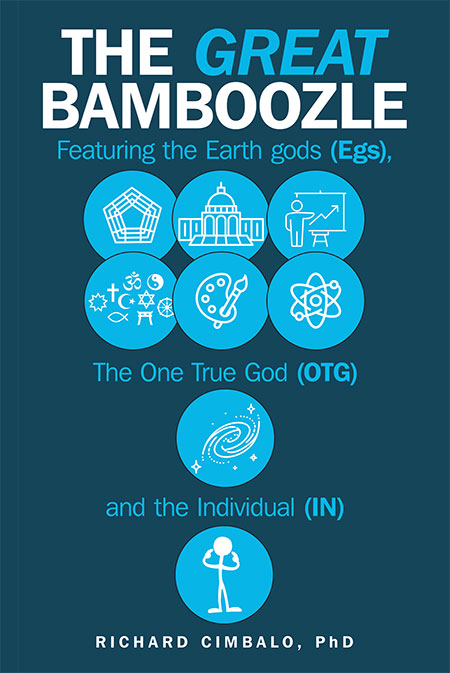
The Great Bamboozle
Richard Cimbalo, PhD
Publisher: Archway Publishing Pages: 144 Price: (paperback) $16.99 ISBN: 9781665778107Reviewed: June, 2026Author Website: Visit »
Psychology Professor Richard Cimbalo’s The Great Bamboozle is an ambitious socio-philosophical treatise offering a pragmatic epistemology that argues that state, military, religious, business, art and science institutions curate and interpret our experiences to cultivate and express power. While he leans frequently on the ideas of French philosopher Michael Foucault, Cimbalo’s ideology tends toward a characteristically American political libertarianism.
Cimbalo argues that because we are psychologically predisposed to see the whole, rather than underlying constituent parts, we are ill-equipped to process difference and individuality. Thus, he seems to argue, as noted above, that truth amounts to exercises in power. Attempting to illustrate how these concepts relate, he weaves his way through numerous recent historical events and political movements and explores the philosophical assumptions underpinning scientific understanding.
It’s a big task, and there are some pitfalls: first, because the connections between ideas often feel loose, and second because Cimbalo’s self-described conservative political views make a number of unnecessary appearances, such as a clunky attempt to cast Oklahoma City bomber Timothy McVeigh as a potentially justified freedom fighter reacting to state overreach symbolized by the Waco siege. When he comes around to describing his theory of power, however, he offers provocative ideas that have considerable implications for science and the pursuit of personal freedom — but certainly the text asks more questions than it answers.
This offering is best suited to readers interested in sociology or philosophy, particularly those with a postmodern bent. Whether readers feel rewarded for the effort is an open question, not because the subjects aren’t worth exploring but because Cimbalo’s connections are often tenuous, personal, or idiosyncratic to his own interests. For readers unafraid of such academic messiness, this book might offer a useful change in perspective to help make sense of the world and our place in it.
Also available in hardcover and ebook.
On June 16, 2026, a friend asked me why I was going back in US history and bringing up the slavery issue and the US Constitutional Convention. He questioned its relevance today. Below is my reply.
— Author
“When the past has strong ties to the present, I’m interested. When a group of men, all white, with military and business backgrounds, in powerful positions AND, being almost 50 % enslavers make decisions that are in effect today, that in my mind reflects the world I live in today. The rich and the powerful, the trillionaire and the billionaires, the politicians like my representatives in NY State who take money from special interests, are a lot like the framers of the Constitution. They build governing structures for their own benefit and do not consult in meaningful ways with the people. I’d like to see governments in nations listen to their people, respect them, and show some concern about their neighbors. I’d like to see the common people who pay the salaries of the politicians be more empowered. They work for us or at least the story that we are told.”
— Richard Cimbalo
No, not all of the framers of the US Constitution owned slaves. Of the 55 delegates who attended the Constitutional Convention in 1787, roughly half (about 25 to 27) were enslavers. [1, 2]
The remaining delegates did not own slaves, and their views on the institution varied widely, ranging from strong abolitionist sentiments to political compromise: [1, 2, 3, 4, 5]
- Prominent Enslavers: Delegates who relied on enslaved labor included George Washington, James Madison, George Mason, and Charles Pinckney. [1, 2]
- Non-Enslavers: Several key figures did not own enslaved people, most notably Alexander Hamilton, Benjamin Franklin (who owned slaves early in life but later became president of an abolitionist society), and Gouverneur Morris. [1, 2, 3]
Would you like to explore specific delegates or learn more about the compromises regarding slavery that took place during the convention? Let me know what you’d like to dive into!